The Future of Education in India: How OnliGrow Is Rebuilding K-12 for the AI Era
A deep look at how AI, skill portfolios, NEP 2020 and platforms like OnliGrow are reshaping Indian K-12 schools — with data, examples and sources.
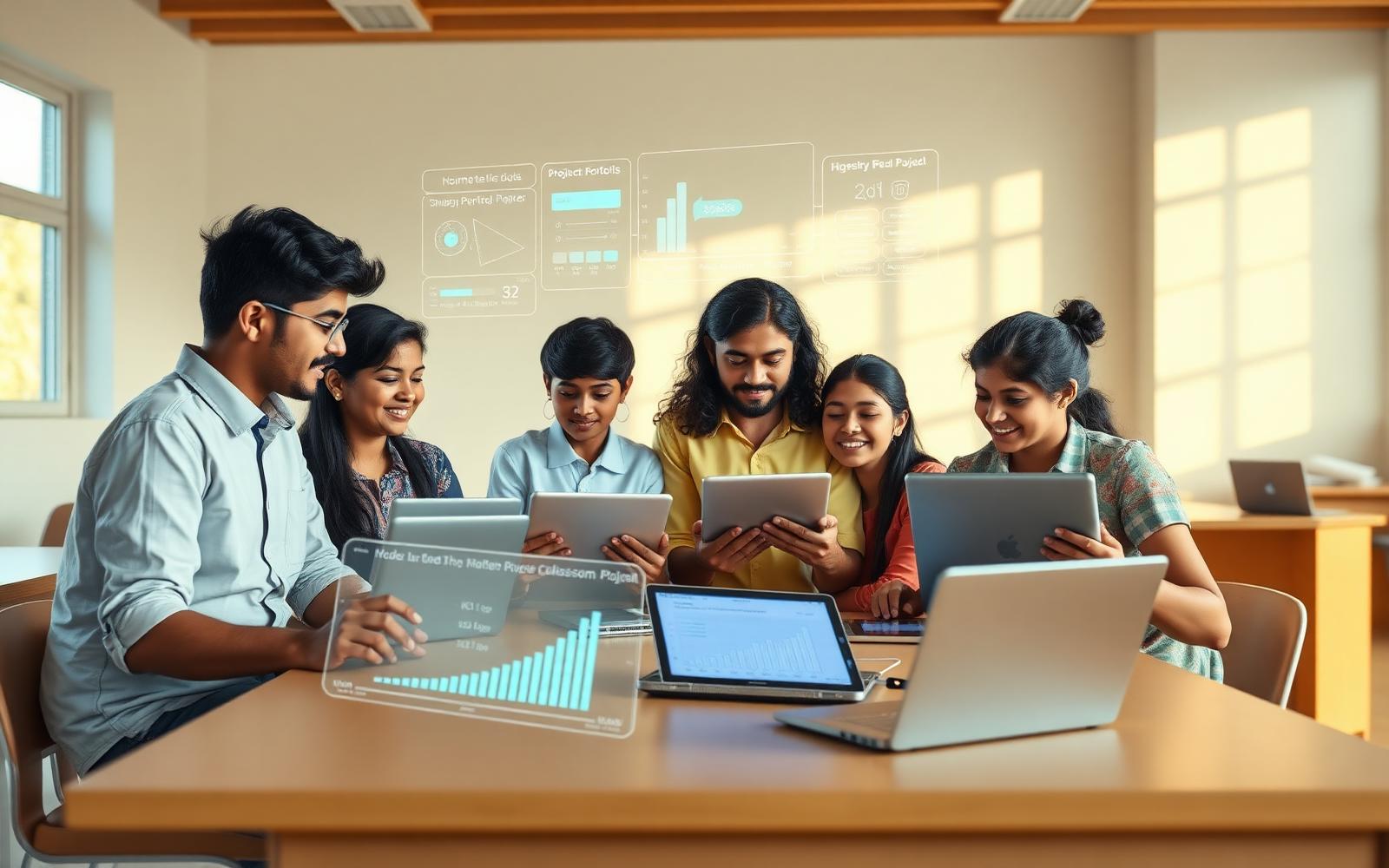
Ask ten Indian school principals what the future of education looks like, and you will get ten versions of the same sentence: more technology, more personalisation, more skills, less rote. Ask them what they are doing about it on Monday morning, and the answers get quieter.
The gap between the future we talk about and the classroom we run is not a vision problem. It is an operating-system problem. Indian schools were built to deliver a syllabus, invigilate an exam, and print a marksheet. The next decade will judge them on something entirely different: whether a 17-year-old walks out with a verifiable, industry-legible record of what they can actually do.
This is a long piece — around a 20 minute read — because the shift underway is not a single feature launch. It is a redesign of what school produces. We will look at the forces reshaping K-12 in India (NEP 2020, AI, the skills economy, the collapse of the marksheet as a hiring signal), then walk through how OnliGrow's platform operationalises that future for a real school on a real budget. Sources are linked at the end so you can verify every claim.
What is the future of education in India? (The short answer)
The future of Indian education is outcome-based, portfolio-visible, AI-assisted, and continuously measured. Schools will be judged not by how much syllabus they covered, but by what percentage of their students left with (a) proven core competencies, (b) a public portfolio of real work, and (c) exposure to industry beyond the classroom. NEP 2020 codifies this direction. AI makes it operationally affordable. Platforms like OnliGrow are the connective tissue that lets a mid-sized Indian school actually deliver it.
That is the AEO-ready summary. The rest of this article is the evidence.
1. The four forces rewriting Indian K-12
Force 1: NEP 2020 and the shift from content to competency
India's National Education Policy 2020 is the most substantial rewrite of school policy since 1986. Its most under-appreciated line is not the 5+3+3+4 restructure or the coding-from-Grade-6 announcement. It is the phrase 'competency-based learning and assessment' repeated across the document. The policy explicitly moves the goalpost from coverage of syllabus to demonstration of competence, and asks CBSE, state boards, and the newly-formed PARAKH to redesign assessments around it.
In practice this means schools will increasingly be asked: how do you know your Grade 9 student can actually apply what they learnt? A marksheet cannot answer that question. A portfolio, a project record, and an outcome dashboard can.
Force 2: AI has quietly become the cheapest personal tutor in history
In 2022, one-on-one tutoring was a luxury good in India — ₹500–₹1500 per hour in Tier-1 cities. In 2026, a well-prompted AI model provides Socratic tutoring, doubt-solving, and personalised worked examples for effectively zero marginal cost. Every study since Bloom's original 1984 '2 sigma' paper has agreed on one thing: individualised instruction is the highest-leverage intervention in education. For the first time in history, the constraint is no longer money. It is design.
This is why the debate has shifted from 'should students use AI?' to 'how does the school channel AI so that it deepens learning instead of hollowing it out?' Schools that answer that question well will produce dramatically stronger cohorts. Schools that ban the tools and pretend will produce students who cheat on Wednesday and cannot think on Friday.

Force 3: The collapse of the marksheet as a hiring signal
India's largest employers — TCS, Infosys, Wipro, and every start-up worth working at — have publicly moved to skill-first hiring. TCS's National Qualifier Test, Infosys's InfyTQ, and the growing weight of GitHub profiles, Kaggle rankings, and design portfolios in interview shortlists all point in the same direction: the marksheet is now table stakes, not a differentiator. The World Economic Forum's Future of Jobs 2023 report projects that 44% of workers' core skills will be disrupted in the next five years. No board syllabus, however well taught, keeps up with that half-life.
The implication for schools is uncomfortable: the artefact you spent 12 years producing — a marksheet — is no longer the artefact your students are judged on. The artefact that matters is a portfolio of visible work. Most Indian schools produce zero of these per graduating student.
Force 4: Parents have finally noticed
The single biggest behavioural change we see in our data at OnliGrow is not from schools. It is from parents. Parents of Grade 8–10 students are Googling 'career counselling', 'coding for kids', 'best schools with skill programs' at rates that have roughly tripled since 2022. They are no longer asking 'what is my child's rank?' They are asking 'what can my child do?' Schools that cannot answer that question in a specific, evidence-backed way will lose enrolments to schools that can.
2. What 'future-ready' actually means for a school in 2030
Strip away the buzzwords and a future-ready Indian school in 2030 has five things a 2020 school did not.
- Every student has a verified institutional email from Grade 6 onwards, which unlocks GitHub Student Pack, Microsoft 365, Google Workspace and Figma Education.
- Every student maintains a live portfolio (a GitHub profile, a portfolio website, or a Behance page) that grows every semester.
- Every subject has at least one project per term with external validation — a competition, a public deployment, a mentor review, a client brief.
- Every classroom has AI in the loop — for doubt-solving, differentiation, rubric-based feedback, and reducing teacher grunt work by 40–60%.
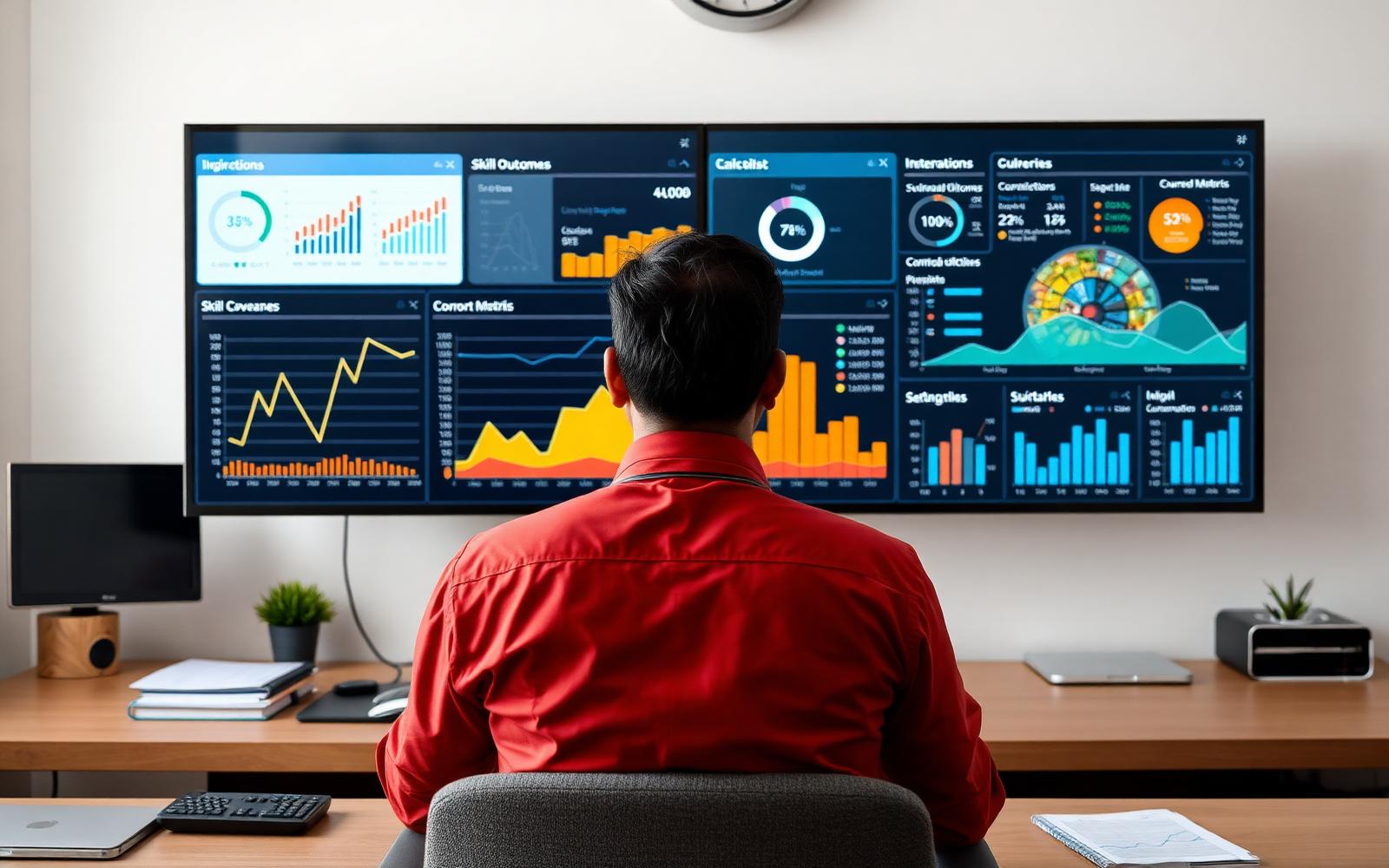
- Every school leader has a live dashboard of skill coverage, outcome distribution, and portfolio depth across cohorts — not a once-a-year marksheet PDF.
None of these are exotic. All of them exist today in the best 200 schools in the country. The question is whether the next 20,000 schools can afford to run them. That is the problem OnliGrow was built to solve.
3. OnliGrow: an operating system for the future-ready school
OnliGrow is not a courseware company. It is not a coaching class. It is not another LMS with a fresh coat of paint. OnliGrow is the operating system that sits underneath a school's academic program and makes future-ready operations affordable and measurable.
Concretely, the platform gives a school four things it did not previously have as a single stack:
- Identity — verified institutional accounts for every student, which unlock the professional toolchain the rest of the world already uses.
- Portfolio — structured, subject-linked project workflows that end in a public artefact, not a graded notebook.
- AI — a curriculum-aware tutor and teacher copilot that is scoped, safe, and observable by the school.
- Analytics — a school-wide dashboard that turns activity into outcomes the principal, the board, and parents can understand.
3a. Identity: the email that unlocks a decade of tools
The first thing OnliGrow does when a school onboards is issue every student a verified institutional email. This sounds trivial. It is the most consequential thing the platform does. That email is what a Grade 8 student uses to claim the GitHub Student Developer Pack, Microsoft 365 Education, Google Workspace for Education, Figma Education, JetBrains for students, Notion for education, and Canva Education — collectively worth over ₹1.5 lakh per student per year in commercial value. Students at schools without institutional email fall back to personal Gmail accounts and unlock none of this.
By the time a student reaches Grade 12, this compounding difference is enormous. One student has a four-year GitHub history, professional design tools, and a Microsoft-verified email on every college application. The other has a Gmail address and a folder of PDFs. Recruiters and college admissions officers can tell the difference in ten seconds.
3b. Portfolio: the artefact the school did not know it was producing
The single largest behavioural change OnliGrow drives in a school is that every project ends in a public artefact. A science project becomes a GitHub repo with a README, a photo essay, and a shareable link. A social studies research paper becomes a Medium post or a portfolio-website case study. A commerce assignment becomes a Notion page with charts. A design brief becomes a Figma prototype.
The platform gives teachers project templates, rubrics that map to NEP 2020 competencies, and submission workflows that require an external link — not a Word document over WhatsApp. Over four years, a student accumulates 30–60 such artefacts. That is a portfolio no marksheet in India can compete with.
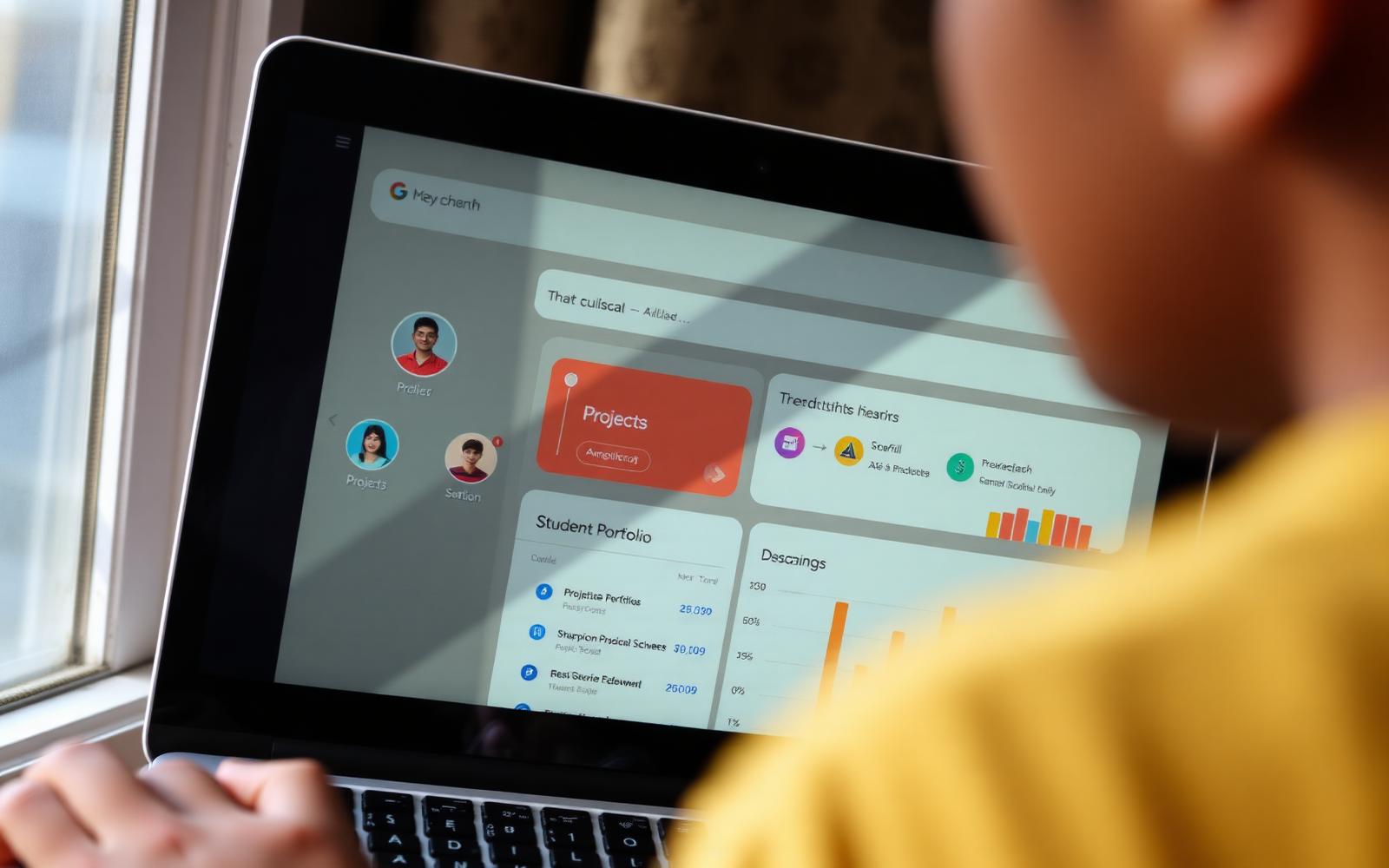
3c. AI: a tutor for every student, a copilot for every teacher
The OnliGrow AI layer does two things a general-purpose chatbot cannot. First, it is scoped to the school's curriculum and the student's current chapter, so it explains at the right level and refuses to just give away answers when the pedagogical goal is to make the student think. Second, it is observable: teachers and parents can see what a student asked, what the AI said, and how the student's understanding is evolving — turning a black box into a learning signal.
For teachers, the copilot handles the low-value work that eats their week: generating differentiated worksheets, drafting rubric-based feedback on written work, converting learning objectives into lesson plans, and translating between English and regional languages for parent communication. Our early pilots show teachers save 6–9 hours per week — time that goes back into actual teaching.
3d. Analytics: from marksheets to outcome maps
The final and most under-rated piece is analytics. OnliGrow gives the principal a single dashboard that answers the questions boards, parents, and inspectors are starting to ask:
- What percentage of our Grade 9 cohort has demonstrated the NEP 2020 competencies we committed to?
- How many of our Grade 11 students have a live portfolio link they could put on a college application tomorrow?
- Which teachers are producing the strongest project outcomes, and what are they doing differently?
- Which students are quietly falling behind on portfolio depth, even though their marks look fine?
- How does our cohort compare to similar schools on our network on skill coverage?
None of these questions have historically had an answer inside a school. Every one of them has an answer inside OnliGrow.
4. What this looks like on a Tuesday morning
Abstractions are easy. Let's walk through what a future-ready OnliGrow-powered classroom looks like on an ordinary Tuesday in a Tier-2 CBSE school.
8:45 AM. A Grade 9 science teacher opens her lesson plan. It was drafted by the AI copilot on Sunday night, aligned to the chapter she is teaching, and adapted to three ability bands based on last week's assessment. She spent 12 minutes reviewing it, not two hours writing it.
9:20 AM. Students break into project pods for the term project — building a small water-quality monitoring rig. Every pod has a private GitHub repo. Documentation is required. The final submission is not a chart-paper display; it is a deployed dashboard link plus a public repo, judged by an external mentor from a partner engineering college.
10:15 AM. A student is stuck on a physics problem. Instead of waiting for the teacher's next period, she opens the OnliGrow tutor. It walks her through a related worked example, asks her a checking question, and only reveals the next step when she has attempted her own. Her attempt log is visible to her teacher.
3:30 PM. The principal opens the dashboard. Portfolio depth is up 14% across Grades 8–10 this quarter. Two Grade 10 sections are trailing on the 'applied maths' competency. She schedules a 15-minute conversation with the two teachers involved. This used to be a conversation she had once a year, in June, based on gut feel.
None of this is science fiction. All of it is running in OnliGrow pilot schools today.
5. The four objections we hear most
'Our teachers are not ready for this.'
This is the objection we take most seriously and it is also the one we have the clearest answer to. OnliGrow is designed so that the AI copilot makes an average teacher 30% more effective on day one, not month six. Adoption is not driven by training. It is driven by the copilot saving the teacher's Sunday evening. That is a hook every teacher understands.
'Parents want board marks, not portfolios.'
Parents want their child to succeed. Board marks were a proxy for that. As college admissions, scholarships and jobs increasingly weight portfolios and skills, parents update the proxy. OnliGrow's parent view is explicitly designed to make the shift visible: a parent sees marks and a live portfolio and a skill map in the same monthly report. Once they have seen it, they do not go back.
'AI will make students lazy.'
AI, badly deployed, absolutely will. A student who copy-pastes answers from a general-purpose chatbot learns nothing. That is why OnliGrow's tutor is Socratic by default, why every AI interaction is logged, and why teachers see attempt patterns, not just final answers. Used well, AI makes students more thoughtful, not less. Used badly, it is a disaster. The design of the interface is the entire game.
'This will cost too much.'
The economics run the other way. A school that runs OnliGrow typically consolidates 3–5 tools it was already paying for (LMS, communication app, project management, doubt-solving), unlocks 1.5 lakhs of student-pack value per learner, saves 6–9 teacher hours per week, and adds a demonstrable skill program that materially improves admissions marketing. For most schools, the platform pays for itself before the outcomes even show up.
6. What Indian schools should do in the next 12 months
If you are running a school and you have read this far, here is the smallest useful set of moves you can make this year, whether or not you ever talk to us.
- Issue every student from Grade 6 upward a verified institutional email. This alone unlocks more than any single course you can buy.
- Add one external-facing project per subject per term. External means a competition, a public deployment, or a mentor review — not a chart-paper display.
- Give every student a portfolio home — GitHub, a portfolio site, or a Behance page — and make maintaining it part of the grade.
- Pilot AI in one department first, with clear observability and one teacher champion. Do not do a school-wide rollout on day one.
- Start measuring one non-marksheet outcome and share it with parents monthly. Portfolio depth, competition participation, project completion — pick one and be honest about it.
If you do these five things, whether with OnliGrow or without us, your school will be materially ahead of 90% of Indian schools in three years.
7. Frequently asked questions
How is OnliGrow different from an LMS like Google Classroom or Moodle?
An LMS is where you hand out worksheets and collect submissions. OnliGrow is where students build a portfolio, teachers get an AI copilot, and principals see outcome analytics. We integrate with Google Classroom and Microsoft Teams — we do not replace them.
Does OnliGrow work for state-board and vernacular-medium schools?
Yes. The AI tutor and teacher copilot support Hindi, Marathi, Tamil, Telugu, Kannada, Bengali and Gujarati today, with more languages in rollout. Portfolio and identity features are curriculum-agnostic and work equally for CBSE, ICSE and state boards.
Is student data safe? What about DPDP compliance?
OnliGrow is designed to be compliant with India's Digital Personal Data Protection Act 2023. Student data is stored in India, parental consent flows are built in for under-18 users, and schools retain full data ownership. AI interactions are not used to train third-party models by default.
What does OnliGrow cost?
Pricing is per-student, per-year and scales with school size. Most schools recover the cost through tool consolidation and student-pack unlocks alone. Contact us for a school-specific ROI calculation.
8. The one line summary
"The future of Indian education is not more content delivered faster. It is a smaller number of things — identity, portfolio, AI, analytics — done every day, for every student, at every school. That is what OnliGrow is building."
Sources and further reading
- Ministry of Education, Government of India — National Education Policy 2020 (full text, PDF)
- PARAKH — National Assessment Regulator, NCERT
- World Economic Forum — Future of Jobs Report 2023
- UNESCO — Guidance for generative AI in education and research (2023)
- Benjamin S. Bloom — 'The 2 Sigma Problem' (Educational Researcher, 1984)
- OECD — PISA 2022 Results, Volume I (student performance)
- NASSCOM — Future of Work and Skills reports
- GitHub Education — Student Developer Pack
- Ministry of Electronics and IT — Digital Personal Data Protection Act, 2023
- AICTE — National Steering Committee reports on skill integration in school education
If you run a school in India and any part of this resonated, we would like to talk. The future of education is not going to be built by policy documents or by keynote talks. It will be built one school at a time, on one Tuesday morning at a time. That is the work OnliGrow exists to do.
Bring this to your school.
OnliGrow turns these ideas into a system your teachers can run and your board can measure.
Book a demo